
Western Indo-Pacific: Connected Coasts Under Pressure
- Shanti

- 7 minutes ago
- 14 min read
How coral reefs, mangroves and seagrass meadows support wildlife, food, water and communities - and what practical action can protect them.
Shanti Plants - The Earth Provides
The Western Indo-Pacific is not one uniform ecosystem. It is a vast connected realm of tropical and subtropical coasts, shelves, islands and shallow seas. Monsoons, currents and local upwelling move heat and nutrients through the region, while coral reefs, mangroves and seagrass meadows provide shelter, nursery habitat, food, cleaner water and coastal protection. These systems are naturally dynamic, but rapid ocean warming and intense local pressures are reducing their capacity to recover.

This article explains what the Western Indo-Pacific is, how its main coastal ecosystems work, what is placing them under pressure, what current evidence can and cannot tell us, and which actions are realistic for households, schools, gardens and community groups. It focuses on connected habitat condition rather than a single species or a single country.
In This Article |
|
Understanding the Western Indo-Pacific
The Western Indo-Pacific is a biogeographic realm: a very large area grouped because its coastal species and evolutionary history share broad patterns. In the Marine Ecoregions of the World system, the full realm extends farther east than the places discussed here, reaching towards the Andaman Sea and western Indonesia (Spalding et al., 2007). This article uses a narrower practical focus that matches the original blog scope: East Africa, Madagascar, the Seychelles, Maldives, Red Sea, Arabian/Persian Gulf and nearby Indian Ocean coasts.
Water movement helps explain why productivity varies so much. Seasonal monsoon winds reverse or strengthen currents in parts of the northern Indian Ocean. In some locations, upwelling brings deeper, cooler and nutrient-rich water towards the surface, feeding plankton and productive food webs. Upwelling can also bring naturally low-oxygen or more acidic water, so it is not simply 'good' or 'bad'; its effect depends on depth, season and local conditions (Vinayachandran et al., 2021).
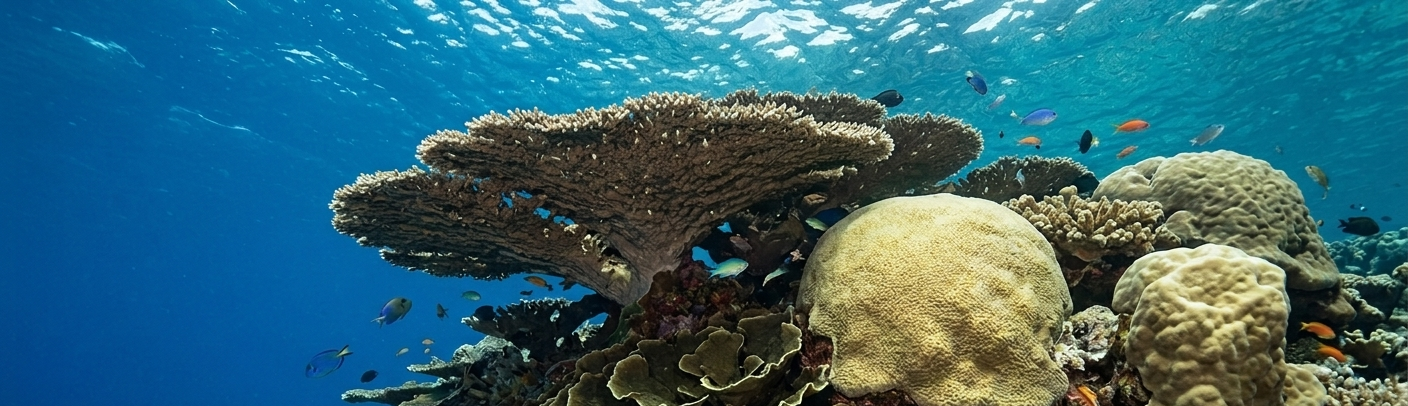
Three habitat groups form much of the living structure along sheltered and shallow coasts. Coral reefs are built by living coral colonies and create complex shelter. Mangroves are salt-tolerant trees and shrubs rooted in tidal soils. Seagrasses are true flowering plants that form underwater meadows. Fish, turtles and invertebrates may use more than one of these habitats as they feed, grow and reproduce, so damage in one place can affect life elsewhere.
What is happening?
Many Western Indo-Pacific coastal ecosystems are still biologically rich, and some places continue to show recovery or unusual heat tolerance. At the same time, the overall pressure is increasing. Marine heatwaves cause coral bleaching, while fishing pressure, poor water quality and habitat removal can reduce the living structure and ecological functions that help reefs recover. Mangroves and seagrasses are also cleared, buried, dredged, shaded or damaged by altered water flow and declining water quality.
Bleaching means heat or another stress has disrupted the relationship between coral animals and the microscopic algae that supply much of their energy. A bleached coral is stressed, not automatically dead. It can recover if conditions improve soon enough; long or repeated heat stress increases the chance of disease, reduced reproduction and death (Intergovernmental Panel on Climate Change [IPCC], 2022).
The Western Indian Ocean is a clear warning case. A regional ecosystem-risk assessment found its coral reefs vulnerable to collapse overall, with the assessed subregions ranging from Vulnerable to Critically Endangered. The strongest drivers differed: projected warming dominated risk for several island systems, while fishing pressure was especially important along parts of the continental coast and northern Seychelles (Obura et al., 2022). This is a risk assessment, not a claim that every reef has already collapsed.
Global context matters because heat does not stop at national boundaries. From January 2023 to March 2025, bleaching-level heat stress affected about 84% of the world's coral reef area, including reefs in the Indian Ocean. Exposure does not equal the same mortality everywhere, but it shows the scale of the thermal pressure (International Coral Reef Initiative [ICRI], 2025).
Quick Facts | |
Main environmental issue | Loss of resilience and degradation across connected coral reef, mangrove and seagrass ecosystems. |
Location or ecosystem | Western Indo-Pacific coastal and shelf waters; this article concentrates on East Africa, the Western Indian Ocean islands, the Red Sea, the Arabian/Persian Gulf and nearby northern Indian Ocean coasts. |
Species affected | Reef-building corals, seagrasses, mangrove plants, reef and coastal fish, sharks and rays, sea turtles, dugongs, seabirds, molluscs, crustaceans and other invertebrates. |
Causes | Ocean warming and marine heatwaves; overfishing; habitat clearing and coastal development; polluted run-off, sewage, sediment and plastics. Other pressures vary by place. |
Practical action level | Household: useful but mainly indirect. School and local group: moderate. Community, industry and government: high. Rapid global emissions reduction remains essential. |
Evidence confidence | High for the main pressures and ecosystem functions; medium for realm-wide generalisation because monitoring and conditions differ greatly among subregions. |
Main environmental issue | Loss of resilience and degradation across connected coral reef, mangrove and seagrass ecosystems. |
Why it matters
Plants
Mangroves and seagrasses are living coastal plants, not background scenery. Their roots and rhizomes stabilise sediment, slow water movement and create feeding and nursery areas. Losing them removes both plant diversity and the physical habitat used by many animals.
Soil and sediment
Mangrove and seagrass soils can store large amounts of carbon for long periods when they remain waterlogged and undisturbed. Clearing, drainage or excavation can expose stored material to oxygen, release greenhouse gases and increase erosion. Protecting intact habitat is generally more reliable than trying to rebuild complex soils later (Macreadie et al., 2021).
Water
Healthy coastal vegetation slows run-off, traps some sediment and nutrients, and helps keep shallow water clear enough for seagrass and coral growth. It cannot absorb unlimited pollution. Excess nutrients, untreated sewage, fine sediment, industrial contaminants and plastics can still overwhelm local systems or move between countries and seas.
Wildlife
Coral structures, mangrove roots and seagrass leaves create shelter at different life stages. When these connected habitats simplify, wildlife can lose feeding grounds, breeding sites and safe nursery areas. Species with small ranges - including many Red Sea endemics - have fewer alternative places if local habitat is lost.
Food
Coastal fisheries depend on functioning food webs and suitable habitat, not only on the number of adult fish seen at one moment. Habitat loss and excessive harvest can act together: fewer juveniles survive, while too many breeding adults or key herbivores are removed. This can reduce food security and income, particularly where households rely on small-scale fishing.
People
Reefs, mangroves and seagrass support fishing, tourism, cultural practice, education and shoreline protection. Their decline can increase costs for food, coastal infrastructure and disaster recovery. Effects are not shared equally; people with limited alternatives are often exposed first and have the least capacity to absorb losses.
Community resilience
A resilient community can prepare for change, recover from disturbance and adapt without losing essential wellbeing or cultural connection. Healthy habitats are one part of that resilience. Fair decision-making, secure access rights, trusted local monitoring, diversified livelihoods and effective public services are also required; conservation cannot substitute for social policy.
Main causes
Direct evidence: pressures well established across the region
Ocean warming and marine heatwaves: elevated temperatures are increasing bleaching risk and shortening recovery time between events. Ocean acidification adds a slower chemical pressure by reducing the availability of carbonate used by corals and other calcifying organisms (IPCC, 2022; Western Indian Ocean Marine Science Association [WIOMSA], 2022).
Fishing pressure and destructive practices: excessive harvest changes fish abundance and food-web balance. Removing herbivorous fish can allow algae to compete more strongly with young corals, while removing large predators and breeding adults changes ecosystem function (Obura et al., 2022).
Habitat clearing and coastal development: dredging, reclamation, ports, roads, tourism infrastructure and poorly located buildings can directly remove or fragment reefs, mangroves and seagrass, alter water flow and increase sediment.
Pollution from land and sea: untreated sewage, nutrient-rich run-off, agricultural chemicals, plastics, industrial discharge, shipping and oil pollution can damage water quality. The relative importance varies locally, but the source-to-sea pathway is well established (Nairobi Convention & WIOMSA, 2025).
Possible or location-specific contributing factors
The following factors can be important, but should not be presented as equally severe everywhere without local data:
Cyclones, floods, disease outbreaks, crown-of-thorns starfish and other natural disturbances. Climate change may alter the frequency or severity of some events, but attribution must be made carefully.
Desalination brine, cooling-water discharge, mining, oil and gas activity, heavy shipping and rapid coastal construction, especially in semi-enclosed northern seas. Effects depend on design, discharge conditions, enforcement and cumulative exposure.
Changes to river flow, dams, groundwater extraction and sediment supply that alter salinity, nutrients or the ability of mangroves and tidal flats to keep pace with sea-level rise.
Invasive species and pathogens moved on vessels, equipment or traded organisms. Local surveillance is needed before identifying them as a main driver.
Tourism damage from anchoring, trampling, wildlife disturbance, wastewater or poorly managed visitor numbers. Responsible tourism can also fund protection when limits and benefits are transparent.
What the evidence shows
The region is connected, but outcomes are uneven
Long-term monitoring in the Western Indian Ocean shows that coral cover and algal cover have not followed one simple regional line. Some subregions declined, some recovered for a period, and data gaps remain. This variation is important: local management can protect recovery capacity, but it cannot fully shield reefs from continued global warming (Souter et al., 2021).
Heat tolerance is valuable, not invulnerability
Some northern Red Sea corals live well below their measured upper temperature limits, making the area a possible climate refuge. Studies comparing northern and southern populations support unusual thermal tolerance in several species. However, tolerance differs among species and locations, and pollution, coastal development, disease or extreme heat can still cause damage (Banc-Prandi et al., 2022). Protecting these reefs is important precisely because their resilience is unusual, not because it is unlimited.
Local pressure and global climate pressure interact
A reef with healthy fish populations, cleaner water and connected nursery habitats usually has more capacity to recover than a reef already stressed by pollution and overfishing. This does not mean local clean-ups can solve climate change. It means the best response works at two levels: rapidly reduce greenhouse gas emissions, while also reducing avoidable local stress and protecting connected habitat (IPCC, 2022; Obura et al., 2022).
Protection alone is not enough if it is only a line on a map
Marine protected areas can support biodiversity and fisheries when they protect the right habitats, include ecological connections, have adequate staff and finance, and are designed with affected communities. Monitoring, fair access rules and enforcement matter. The 2025 Western Indian Ocean Critical Habitats Outlook calls for stronger management, monitoring, regional cooperation and integration of reef protection into wider coastal planning (Nairobi Convention & WIOMSA, 2025).
Restoration is useful after causes are addressed
Planting mangroves or corals into the wrong place can waste resources and damage naturally open habitats. Successful restoration starts by identifying why the habitat declined, restoring hydrology and water quality where possible, choosing suitable reference sites and monitoring survival and function. Protecting intact habitat is usually the first priority; restoration supports, but does not replace, emissions reduction and threat prevention.

Avoid | Do This Instead |
[Repeating a claim without checking its source] | [State the source, date, place and evidence limits] |
[Taking an unsafe, illegal or harmful action] | [Use the safest lawful action and approved reporting pathway] |
[Using one solution for every place or species] | [Adapt the action to local conditions and guidance] |
What you can do at home
For readers outside the Western Indo-Pacific, household actions are mostly indirect. Water from a Brisbane garden does not flow to Madagascar or the Red Sea, but the same source-to-sea practices protect local coasts, while lower emissions, responsible purchasing and well-chosen support contribute to global ocean resilience.
Home gardens
Keep soil covered with plants or mulch so heavy rain carries less sediment into drains and waterways.
Use fertiliser only when plants need it, follow the label and keep it off hard surfaces before rain.
Choose lower-toxicity pest management first and never tip pesticides, paint, oil or garden chemicals into gutters or stormwater drains.
Slow and filter run-off with rain gardens, planted swales or permeable surfaces where these are suitable and lawful.
Reduce household greenhouse gas emissions through practical energy, transport and purchasing choices within your capacity.
Balconies and small spaces
Secure pots, artificial turf fragments and lightweight materials so wind and rain cannot carry them into drains.
Use trays carefully: do not allow fertiliser-rich water to overflow into shared drainage systems.
Choose durable, reusable garden materials and avoid products that shed glitter, foam or loose plastic pieces.
Join a local river, wetland or coast group if direct habitat work is not possible at home.
Schools
Map the path from the school grounds to the nearest drain, creek, river and coast, then identify where litter, sediment and nutrients can be stopped.
Run a waste or stormwater audit and record results before and after changes rather than relying on a one-day activity.
Teach that seagrasses are flowering plants and corals are animals living with microscopic algae; clear concepts support better stewardship.
Use authorised citizen-science programs and do not collect coral, shells, seagrass or mangrove material for classroom displays without permission.
Community gardens
Create a simple nutrient plan for compost and fertiliser so 'organic' inputs are not over-applied.
Stabilise bare paths and soil piles, especially before the wet season.
Capture rainwater where lawful and manage overflow so it does not erode soil.
Share source-to-sea signs or workshops that connect soil care with creek, estuary and ocean health.
Local groups
Record the types and likely sources of litter collected, not only the total number of bags.
Support long-term water-quality or habitat monitoring with an established method and data custodian.
Buy seafood using current, location-specific guidance and ask suppliers about species, fishing method and origin.
Support credible Western Indo-Pacific organisations that publish goals, local partnerships, evidence and outcomes.
What communities can do
Reduce pressure from catchment to coast
Coordinate farms, councils, utilities, schools and residents around a shared source-to-sea plan. Priorities may include sewage treatment, erosion control, riverbank vegetation, wetland protection, litter interception and industrial discharge compliance. Measure water and habitat outcomes, not only participation numbers.
Restore habitat in the right order
First protect intact areas and remove the cause of damage. Then restore water flow, sediment conditions and water quality before planting. Use local ecological knowledge and qualified specialists to choose methods. Monitor survival, natural recruitment, wildlife use and unintended impacts over several years.
Build monitoring people can trust
Combine standard scientific methods with locally held knowledge where permission is clear. Train community monitors, publish methods, keep sensitive species locations private and return results in useful formats. A photograph is valuable evidence of a condition at a time and place, but it is not a complete ecological assessment on its own.
Manage fishing with communities, not around them
Co-design seasonal closures, gear rules, nursery-area protection and no-take zones with fishers, customary authorities, women and other affected groups. Pair rules with fair enforcement, food-security planning and realistic livelihood support. Track ecological and social outcomes so management can adapt.
Use education and tourism carefully
Train guides and operators in anchoring, wildlife distance, wastewater, reef-safe conduct and visitor limits. Make fees and conservation contributions transparent. Education should explain uncertainty and regional differences rather than promise that one behaviour or product can 'save the reef'.

Conservation and Safety Notice |
LEGAL, ENVIRONMENTAL AND BIOSECURITY CHECK Laws differ among countries, islands, marine protected areas and customary or culturally governed places. Do not collect, buy, handle, move, plant or release coral, shells, live rock, seagrass, mangrove material or marine wildlife without checking local permission, protected-species rules and biosecurity requirements. Restoration and monitoring may require permits, land or sea-country authority, cultural permission and trained supervision. Clean and dry footwear, dive, boating and sampling equipment between sites to reduce the movement of pests and pathogens. Travellers returning to Australia must declare relevant animal, plant, soil and biological material and check BICON; corals and clam shells can also be regulated under CITES and wildlife-trade law (Australian Government Department of Agriculture, Fisheries and Forestry, 2026). When unsure, leave the item where it is and seek advice from the responsible local authority. |
Evidence and Review | |
Coverage | Connected coral reef, mangrove and seagrass ecosystems; major pressures, ecosystem functions and practical actions. It does not provide site-specific fishing, restoration, travel or legal advice. |
Geographic limits | Western Indo-Pacific realm with a practical focus on East Africa, Western Indian Ocean islands, the Red Sea, Arabian/Persian Gulf and nearby northern Indian Ocean coasts. Evidence from a subregion is labelled and is not assumed to apply everywhere. |
Evidence level | Established: ocean warming, bleaching risk, habitat connections and broad ecosystem services. Supported: regional fishing, pollution and development pressures. Emerging/location-specific: thermal refugia, local restoration outcomes and future community adaptation. |
Confidence | High for the main pressures and functions; medium for realm-wide detail because monitoring coverage, governance and environmental conditions are uneven. |
Safety review | Draft editorial and public-safety check completed 10 August 2026. Final review by a qualified regional marine specialist and publication editor is required before publishing. |
Cultural rights check | No restricted traditional or cultural knowledge is included. Permission is required before adding local names, quotes, knowledge, photographs, sensitive sites or community case studies. |
Last reviewed | 10 August 2026 |
Next review | 10 August 2027, or earlier after a major regional habitat assessment, bleaching update, legal change or material correction. |
Publication status | Draft - evidence checked; final human review and Wix mobile/SEO checks pending. |
Key Takeaways |
The Western Indo-Pacific is a network of different but connected coasts, not one uniform reef. Ocean warming is the largest shared pressure, while fishing, polluted run-off and habitat damage shape local recovery. The most useful response combines rapid emissions reduction with cleaner water, sustainable fishing, protection of intact mangroves and seagrass, and carefully planned restoration. Start with one measurable source-to-sea action and support community-led work that reports evidence, limits and outcomes honestly. |
References
APA 7 style. Sources are prioritised from government, intergovernmental, university and peer-reviewed publications. The 2007 source is retained because it is the original Marine Ecoregions of the World classification used to define the realm.
Australian Government Department of Agriculture, Fisheries and Forestry. (2026, March 12). Bringing or mailing goods to Australia. https://www.agriculture.gov.au/biosecurity-trade/travelling/bringing-mailing-goods
Banc-Prandi, G., Evensen, N. R., Barshis, D. J., Perna, G., Omar, Y. M., & Fine, M. (2022). Assessment of temperature optimum signatures of corals at both latitudinal extremes of the Red Sea. Conservation Physiology, 10(1), coac002. https://doi.org/10.1093/conphys/coac002
Intergovernmental Panel on Climate Change. (2022). Climate change 2022: Impacts, adaptation and vulnerability. Contribution of Working Group II to the Sixth Assessment Report of the Intergovernmental Panel on Climate Change. Cambridge University Press. https://doi.org/10.1017/9781009325844
International Coral Reef Initiative. (2025, April 23). 84% of the world's coral reefs impacted in the most intense global coral bleaching event ever. https://icriforum.org/4gbe-2025/
Macreadie, P. I., Costa, M. D. P., Atwood, T. B., Friess, D. A., Kelleway, J. J., Kennedy, H.,
Lovelock, C. E., Serrano, O., & Duarte, C. M. (2021). Blue carbon as a natural climate solution.
Nature Reviews Earth & Environment, 2, 826-839. https://doi.org/10.1038/s43017-021-00224-1
Nairobi Convention & Western Indian Ocean Marine Science Association. (2025). Western Indian Ocean critical habitats outlook: Towards achievement of the Global Biodiversity Framework targets. https://www.nairobiconvention.org/sites/default/files/clearinghouse/Western%20Indian%20Ocean_CriticalHabitatsOutlook_0.pdf
Obura, D., Gudka, M., Samoilys, M., Osuka, K., Mbugua, J., Keith, D. A., Porter, S., Roche, R., van Hooidonk, R., Ahamada, S., Araman, A., Karisa, J., Komakoma, J., Madi, M., Ravinia, I., Razafindrainibe, H., Yahya, S., & Zivane, F. (2022). Vulnerability to collapse of coral reef ecosystems in the Western Indian Ocean. Nature Sustainability, 5(2), 104-113. https://doi.org/10.1038/s41893-021-00817-0
Souter, D., Planes, S., Wicquart, J., Logan, M., Obura, D., & Staub, F. (Eds.). (2021). Status of coral reefs of the world: 2020. Global Coral Reef Monitoring Network and International Coral Reef Initiative. https://gcrmn.net/2020-report/
Spalding, M. D., Fox, H. E., Allen, G. R., Davidson, N., Ferdana, Z. A., Finlayson, M., Halpern, B. S., Jorge, M. A., Lombana, A., Lourie, S. A., Martin, K. D., McManus, E., Molnar, J., Recchia, C. A., & Robertson, J. (2007). Marine ecoregions of the world: A bioregionalization of coastal and shelf areas. BioScience, 57(7), 573-583. https://doi.org/10.1641/B570707
Vinayachandran, P. N. M., Masumoto, Y., Roberts, M. J., Huggett, J. A., Halo, I., Chatterjee, A., Amol, P., Gupta, G. V. M., Singh, A., Mukherjee, A., Prakash, S., Beckley, L. E., Raes, E. J., & Hood, R. (2021). Reviews and syntheses: Physical and biogeochemical processes associated with upwelling in the Indian Ocean. Biogeosciences, 18(22), 5967-6029. https://doi.org/10.5194/bg-18-5967-2021
Western Indian Ocean Marine Science Association. (2022). Report on ocean acidification monitoring in the Western Indian Ocean. WIOMSA Series (Online), No. 2. https://www.wiomsa.org/publications/report-on-ocean-acidification-monitoring-in-the-western-indian-ocean-region/
Related learning
Keep Learning with Shanti Plants | ||
 Download related field guides and practical resources for the issue or ecosystem. |  Explore related environmental learning, restoration methods and community action. |  Become a member for full access to reviewed environmental learning and resources. |
Shanti Plants | South East Queensland, Australia | © 2026 Shanti Plants


Comments