

What is the Earth Resource Map?
The Earth Resource Map (ERM) is a long-term global knowledge project being built through Shanti Plants to help people understand the natural world around them.
The ERM is designed to connect reliable information from scientific databases, governments, research, agriculture, environmental organisations, specialist collections and other appropriate sources of knowledge.
Rather than simply collecting information, the ERM is being built to preserve the relationship between a piece of knowledge, the evidence supporting it and where that information came from.
Depending on the resource, the ERM may eventually help people answer practical questions such as:
-
What is this?
-
Where does it occur?
-
What environment does it need?
-
Can it be cultivated?
-
Can it be responsibly harvested or used?
-
What does it depend on?
-
What depends on it?
-
Are there important safety concerns?
-
How can the surrounding environment be protected or restored?
The ERM is not intended to replace scientists, primary research, local expertise or professional advice.
It is intended to make reliable information easier to find, understand and connect.
The long-term vision
A free, global and eventually multilingual knowledge resource that can help people understand the natural resources and ecosystems around them, wherever they live.
Why independent review matters.
The Earth Resource Map is too large and too important to rely on one person's judgement alone.
I am building the ERM's foundations, but I do not want to pretend that one person can independently verify every scientific, technical, legal and environmental decision involved in a project of this scale.
Different specialists notice different kinds of problems.
-
A botanist may recognise an identification issue.
-
A mycologist may identify a toxicity or classification concern.
-
An ecologist may challenge an assumption about habitat or species relationships.
-
A conservation specialist may recognise information that should be restricted or generalised rather than published precisely.
-
A database or security specialist may find a technical weakness before much more information depends on it.
-
A legal or information-rights specialist may identify licensing, attribution, copyright or publication issues that need to be resolved before information is shared more widely.
That is why the first fundraising stage is focused on independent review and strengthening the foundations, rather than simply making the database larger.
I would rather discover a problem early and fix it than build something much larger on top of a weak foundation.
The ERM is being designed around evidence, transparency and the ability to revise information when better evidence becomes available. The goal is not to prove the ERM is already perfect. The goal is to create a system that can be questioned, corrected and strengthened as it grows.
Scientific & specialist review
Botany, mycology, zoology, ecology, conservation, safety and responsible use.
Technical & data review
Database structure, reconciliation, quality control, provenance, security, performance and scalability.
Legal & information-rights review
Licensing, copyright, attribution, contributor terms, privacy and responsible publication.
Global & regional review
Translation, terminology, local environmental context and participation from people who understand different regions.
What has already been built.
The Earth Resource Map is already being built, source by source and system by system.
The project began with the structures needed to organise knowledge carefully rather than simply collecting large amounts of information.
The ERM already has foundational architecture for geography, ontology, object types, predicates and governance concepts. Its founding specification separates the system into seven connected areas: geography, ontology, objects, assertions, evidence, media and governance.
Since that foundation was established, development has moved into controlled data ingestion, reconciliation, review workflows and public interfaces.
Global biological foundation
A controlled biological backbone is being built from recognised authority data so ERM records can be matched to stable biological identities rather than relying only on names.
Mineral foundation
A separate mineral authority structure is being developed so geological resources are handled appropriately rather than being forced into the biological model.
Source tracking & provenance
The ERM records where information came from, with source, licensing and provenance information retained as part of the controlled workflow.
Controlled import & reconciliation
Source information is staged, checked, reconciled and reviewed before it becomes accepted ERM knowledge.
Evidence-based information structure
The system is being designed so claims can be connected to evidence and reviewed, revised or held where support is not strong enough.
Public ERM interface
A public search and record interface is being developed through Shanti Plants so people can eventually search the ERM and find local plants, fungi, animals and minerals that matter to them.
Australian sources are already being connected
Australian environmental and biodiversity sources are being used as an early development and testing ground for the wider system.
Current work has included areas such as:
-
Queensland and South East Queensland biodiversity data;
-
wetland and environmental records;
-
species-trait information;
-
conservation information;
-
protected-species information;
-
and controlled reconciliation against global authority data.
This allows the ERM to test the full process:
source → import → reconcile → review → accept, hold or reject → connect to an ERM record → publish appropriate information.
That workflow is important because the goal is not simply to import as much data as possible.
The goal is to understand what the information means, where it came from, whether it can be trusted, and whether it should be published.
The ERM is being built as infrastructure for knowledge, not just as a collection of records.
The information can grow over time, but the structure supporting it needs to be strong enough to preserve evidence, uncertainty, provenance and review.
Architecture established
Authority data loading
Evidence enrichment & review
Public ERM records
Current stage: building and testing the global foundation while connecting real source data.
What the first funds will support.
The first fundraising milestone is focused on strengthening the foundations of the Earth Resource Map.
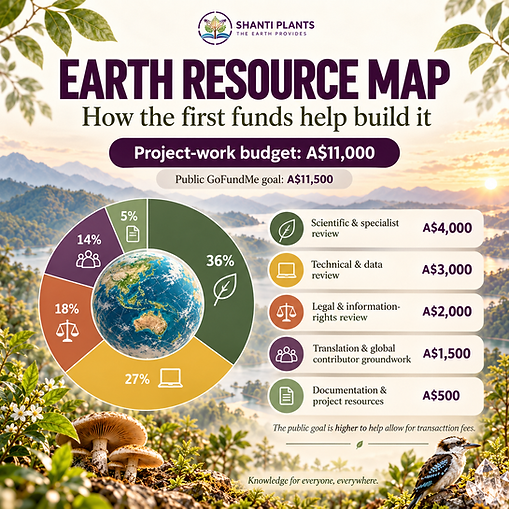
The initial project-work budget is A$11,000, with funds planned across scientific, technical, legal and global-participation work.
The aim is to bring in independent expertise where it can have the greatest impact while the ERM is still developing.
Scientific & specialist review
$4,000
Support independent review across areas such as:
-
botany;
-
mycology;
-
zoology;
-
ecology;
-
conservation;
-
restoration;
-
identification;
-
toxicity and safety;
-
responsible harvesting and use;
-
and environmental impacts.
The purpose is not just to add more information. It is to help identify mistakes, weak evidence, missing context and information that may need to be restricted or presented differently.
Technical & data review
$3,000
Support independent checking of areas such as:
-
database structure;
-
data reconciliation;
-
data cleaning;
-
provenance;
-
quality-control systems;
-
programming;
-
security;
-
performance;
-
search;
-
scalability;
-
and future multilingual functionality.
This work helps make sure the technical foundation can support a much larger knowledge system over time.
Legal & information-rights review
$2,000
Support professional advice around:
-
dataset licences;
-
copyright;
-
database rights;
-
attribution;
-
derivative information;
-
contributor terms;
-
privacy;
-
source archiving;
-
and responsible publication.
The ERM needs to understand not only whether information is useful, but also whether it can be legally and responsibly stored, transformed and published.
Global & regional review
$1,500
Begin preparing the project for participation beyond Australia, including:
-
translation;
-
regional terminology;
-
local environmental context;
-
future contributors;
-
and participation from people who understand different environments and knowledge systems.
A global ERM cannot simply be an Australian system with more countries added to it. It needs to be usable and understandable in different places.
Documentation & project resources
$500
Support directly related project documentation, review materials and resources needed to carry out and record the work properly.
These are planning allocations, not professional quotations.
Actual expenditure will depend on the specialists available, the work required and what independent review discovers.
If less is raised, available funds will be directed to the highest-priority work that can be properly supported.
If more is raised, additional specialist review, technical work, legal and licensing advice, translation, accessibility and regional participation can be funded.
The goal is not to make the ERM bigger as quickly as possible. The goal is to make the foundations stronger before the project grows much larger.
A$11,000 funding breakdown.
Area
Scientific & specialist review
Technical & data review
Legal & information-rights review
Translation & global contributor groundwork
Documentation & project resources
Total project-work budget
Planned amount
A$4,000
A$3,000
A$2,000
A$1,500
A$500
A$11,000
Public GoFundMe goal: A$11,000

These figures are planning allocations rather than fixed professional quotations. Actual spending may change depending on specialist availability, the work required and what is identified during review.
Campaign reporting will separately track:
gross funds raised, GoFundMe transaction fees, net funds received, and directly related project expenditure.
If less is raised
Funds will be directed to the highest-priority review and strengthening work that can be properly completed with the money available.
If more is raised
Additional funds can support further scientific review, technical and security work, legal and licensing advice, translation, accessibility, regional participation and documentation.
This fundraiser is not being presented as a registered charity fundraiser. Contributions are not being represented as tax-deductible donations. Professional advice will be obtained regarding the appropriate Australian tax treatment of crowdfunding receipts and project expenditure.
You don't have to donate to help.
Financial support is only one way to help build the Earth Resource Map.
A project intended to work across different species, resources, ecosystems, regions and eventually languages cannot be built from one person’s knowledge or experience.
Scientists, specialists, developers, data professionals, translators, educators, local knowledge holders, testers and interested community members may all be able to contribute something valuable.
You do not need to know everything about the ERM to help.
Sometimes the most useful contribution is simply recognising something that doesn’t look right, asking a question the project has not considered, or testing whether information makes sense to someone seeing it for the first time.
Scientific & specialist knowledge
help review identification, ecology, conservation, cultivation, safety, responsible use and other subject-specific information.
Technical & data skills
help examine databases, data quality, reconciliation, software, security, accessibility and system design.
Legal & information-rights
help strengthen approaches to licensing, attribution, copyright, privacy and responsible publication.
Translation & regional knowledge
help the ERM understand different languages, terminology, environments and regional contexts.
Testing & feedback
use the public ERM, identify confusing information, report problems and suggest improvements.
Community participation
ask questions, share the project, suggest useful information needs and help identify what people would actually want from a resource like this.
Contributing information does not automatically make it part of the Earth Resource Map.
Information offered to the ERM must still go through the appropriate contribution, evidence and review process before it can become accepted ERM knowledge.
Do you think this is worth building?
The fundraiser is also a way to test something bigger than funding.
I want to know whether people actually want a resource like the Earth Resource Map to exist — and what they would want it to help them understand.
The ERM is being designed as a global project, which means it cannot be shaped only by the questions, environments or priorities familiar to me.
Different places will need different information.
Different communities may use the same resource in very different ways.
And some of the most important questions may be ones I have not thought to ask yet.
If the Earth Resource Map existed in your language and covered the natural world around you, what would you want it to tell you?
Would you want to know:
-
what a species or resource is;
-
where it occurs;
-
how to identify it;
-
what environment it needs;
-
whether it can be cultivated;
-
whether it can be responsibly harvested or used;
-
what is known about safety;
-
what conservation protections apply;
-
what other species depend on it;
-
how it fits into the surrounding ecosystem;
-
or something completely different?
You do not need to be a specialist to answer this question.
Gardeners, teachers, students, families, landholders, travellers, community groups, researchers and people simply curious about the natural world may all see different possibilities for the ERM.
Your perspective can help reveal what is missing.
Free Knowledge, responsible access.
The Earth Resource Map is being built as a free public knowledge resource.
The long-term aim is to make reliable information about the natural world easier for people to access regardless of where they live or whether they can afford a subscription.
Access to the underlying public ERM records is not intended to become a paid product.
Paid Shanti Plants memberships may eventually provide additional tools that help people organise, plan or use information — but they are separate from access to the core public knowledge.
The knowledge belongs in the public resource. The tools help people use it.
Open access must still be responsible.
There will be situations where publishing exact information could cause harm.
For example, some information may need to be withheld, generalised or handled differently when it involves:
-
locations of threatened or highly collectable species;
-
culturally restricted or community-controlled knowledge;
-
private personal information;
-
information that could increase environmental damage or illegal harvesting;
-
safety-sensitive information;
-
material that the ERM does not have permission to republish;
-
or information whose reliability has not yet been established.
The aim is not secrecy.
The aim is to make as much useful knowledge available as possible without ignoring conservation, cultural responsibility, safety, privacy or information rights.
Free public knowledge
-
Identification
-
Distribution and ecology
-
Evidence and sources
-
Cultivation information where appropriate
-
Conservation information
-
Responsible-use information
-
Environmental relationships
-
General educational information
Responsible access
Sensitive locations
Restricted cultural knowledge
Private information
Unsafe or harmful detail
Unresolved licensing
Unverified claims
Information requiring specialist review
Accessible does not have to mean unrestricted.
The ERM can make knowledge easier to discover while still protecting information that should not be published precisely or without context.
Free knowledge and paid tools can coexist
The core public Earth Resource Map and Shanti Plants membership tools serve different purposes.
ERM public records provide the underlying knowledge.
Membership tools may help an individual apply that knowledge to things such as their garden, planting plans, maintenance, harvests, recipes, projects or personal records.
A person's private membership information does not automatically become ERM data, and paying for a membership does not buy privileged access to the underlying public ERM knowledge.
That keeps the public knowledge resource separate from the services built around it.
The goal is an ERM that is genuinely useful because people can access it — and genuinely responsible because access is considered alongside evidence, conservation, culture, safety and rights.
Free where it can be. Protected where it should be. Transparent about the difference.
How funds and progress will be reported.
If people support the Earth Resource Map, they should be able to see what that support helped achieve.
Campaign funds will be tracked separately from ordinary Shanti Plants operating expenses, with project expenditure recorded against the work the fundraiser is intended to support.
Updates will focus on real progress — including work completed, problems discovered, decisions changed and areas that still need further review.
Funds received
Campaign reporting will distinguish between:
-
gross contributions;
-
GoFundMe transaction fees;
-
net funds received;
-
and directly related ERM expenditure.
Where funds were used
Expenditure will be grouped into the main project areas, including scientific and specialist review, technical and data work, legal and information-rights advice, translation and global participation groundwork, and directly related project resources.
What the work achieved
Updates will explain what was actually completed — for example, a specialist review, technical improvement, licensing decision, documented correction or new project capability.
What went wrong or changed
If review identifies a problem, delay, incorrect assumption or weakness in the ERM, that should be reported too.
The purpose of independent review is to find problems while they can still be corrected.
Progress reporting should include corrections as well as achievements.
A project built around evidence needs to be able to say:
We checked this.
We learned something new.
We changed it.
Follow the build
Campaign updates can include:
what was worked on;
what was completed;
what was independently reviewed;
what was changed or corrected;
what remains unresolved;
how campaign funds have been used;
and what comes next.
Plans may change as the project develops.
The funding allocations shown on this page are planning estimates rather than fixed quotations.
If less funding is available, the highest-priority work will be addressed first.
If costs, specialist availability or review findings change the original plan, the reason for that change will be explained in project updates.
Transparency does not mean publishing information that should remain protected.
Financial reporting and project updates may summarise work without disclosing private professional information, confidential legal advice, security-sensitive details, culturally restricted knowledge or sensitive environmental information.
The aim is simple: if people help build the Earth Resource Map, they should be able to follow what is being built.
What worked. What didn’t. What changed. What was learned. And what comes next.
Frequently asked questions.
What is the Earth Resource Map?
The Earth Resource Map (ERM) is a long-term global knowledge project being built through Shanti Plants.
Its aim is to make reliable information about species, ecosystems and natural resources easier to find, understand and connect, while preserving evidence, provenance and uncertainty.
Is the Earth Resource Map already being built?
Yes.
The ERM is already under active development.
Work has begun on its knowledge architecture, authority data, source tracking, reconciliation and review processes, evidence structures and public search and record interfaces.
The fundraiser is not asking people to fund an idea before anything exists. It is intended to help strengthen work that is already underway.
What will the fundraiser pay for?
The first A$11,000 project-work budget is planned for:
A$4,000 — scientific and specialist review
A$3,000 — technical and data review
A$2,000 — legal and information-rights review
A$1,500 — translation and global contributor groundwork
A$500 — documentation and project resourcesThe public GoFundMe target is A$11,500 to help allow for transaction fees.
These amounts are planning allocations rather than fixed professional quotations.
Why does the ERM need independent specialists?
The project covers areas that no single person can responsibly assess alone.
Scientists, environmental specialists, developers, data professionals, legal specialists, translators and people with regional knowledge may identify problems that someone outside their field would not recognise.
Independent review is intended to find weaknesses while the project's foundations can still be corrected.
What happens if the campaign raises less than A$11,500?
The available funding will be directed to the highest-priority work that can be properly completed with the amount raised.
The project does not need to reach the entire target before useful strengthening work can begin.
Campaign updates will explain what work was prioritised and what remains outstanding.
What happens if the campaign raises more than A$11,500?
Additional funding can support further specialist review, technical and security work, legal and licensing advice, translation, accessibility, regional participation and project documentation.
Any expansion beyond the original funding plan will be reported through campaign updates.
What happens if the campaign raises more than the target?
The core public ERM is being built as a freely accessible knowledge resource.
Shanti Plants may offer paid tools or memberships that help people organise, plan or apply that information, but payment is not intended to be required to access the underlying public ERM records.
The ERM’s founding stewardship commitment is to keep the project freely accessible wherever doing so is legally, ethically and culturally appropriate.
Does free access mean every piece of information will be public?
No.
Some information may need to be withheld, generalised or restricted.
Examples could include sensitive locations of threatened species, culturally restricted knowledge, private information, safety-sensitive material, unresolved licensing issues or information that has not been adequately verified.
The goal is to make knowledge accessible responsibly, rather than treating unrestricted publication as automatically appropriate.
Do I have to donate to help?
No.
The ERM can also benefit from scientific expertise, technical skills, legal and licensing knowledge, translation, regional knowledge, testing, feedback and community participation.
People can offer knowledge, skills or time through the ERM contribution pathway.
Button:
Contribute to the ERMLink to:
/learn/community/contribute
Will information I contribute automatically appear in the ERM?
No.
Submitting information does not automatically make it accepted ERM knowledge.
Contributed information needs to go through the appropriate evidence, provenance and review process before it can become part of the public resource.
This protects both the quality of the ERM and the people, places and knowledge represented within it.
How will I know what happens to the money?
Campaign funds and directly related expenditure will be tracked and reported.
Updates are intended to show:
gross funds raised;
transaction fees;
net funds received;
where project funds were spent;
what work was completed;
what was learned;
what changed;
and what comes next.
The aim is to report corrections and setbacks as well as achievements.
Is this a registered charity fundraiser? Are contributions tax deductible?
No.
This fundraiser is being run in connection with the Earth Resource Map project through Shanti Plants. It is not being presented as a registered charity fundraiser.
Contributions are not being represented as tax-deductible donations.
Professional advice will be obtained regarding the appropriate Australian tax treatment of crowdfunding receipts and project expenditure.
Who is building the Earth Resource Map?
The ERM is being developed through Shanti Plants.
The project began with one founder building its initial architecture, systems and data workflows, but the long-term intention is not for one person to determine every part of the knowledge resource.
Independent specialists, contributors and communities will be important to strengthening it as it develops.
Latest project updates
Follow the Earth Resource Map as it is built.
Project updates will document real progress, problems, corrections, review findings and the next steps in development.
The aim is to show not only what has been completed, but also what has been learned and what still needs work.
September 2026 — Building the ERM foundation
September focused on establishing and testing the systems needed to move the Earth Resource Map from architecture into a working knowledge resource.
Work included global biological authority data, Australian environmental datasets, controlled reconciliation and review workflows, public search and record development, and preparation for the next stage of specialist review.
October 2026 — From loading data to strengthening the system
October is focused on reconciling the global authority foundation, processing additional datasets through the full controlled workflow, improving the public ERM record experience and preparing the project for independent scientific, technical and legal review.
The goal is to move from simply loading information toward proving that the full system can reliably review, preserve and publish it.
Future updates will include what we built, what we learned, what changed and what comes next.
Knowledge for everyone, everywhere.