
Temperate South America Marine Realm
- Shanti

- Jul 27
- 4 min read
Discover the Temperate South America Marine Realm: Coastal Ecosystems, Wildlife, Ocean Currents and Conservation
Shanti Plants – The Earth Provides
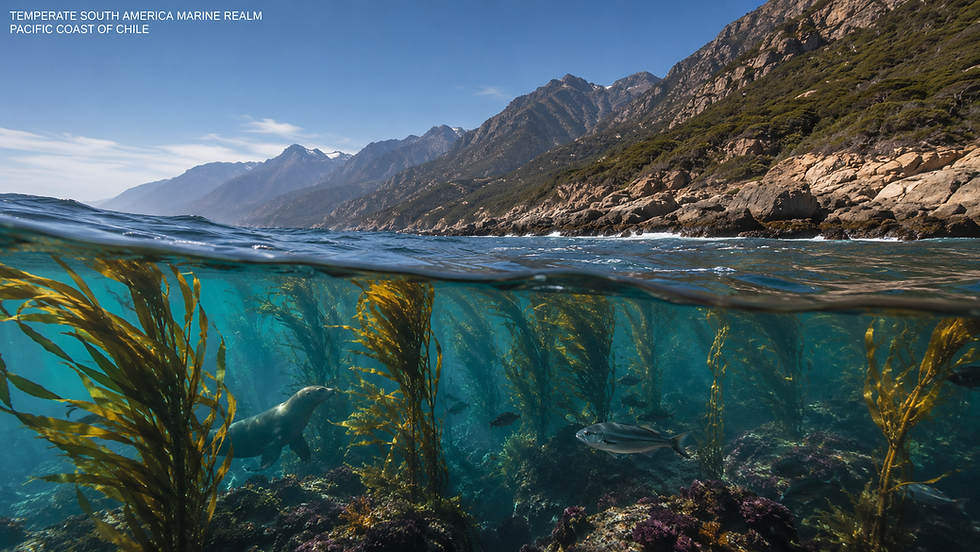
2. Introduction
The Temperate South America (TS) Marine Realm encompasses the temperate and subtropical waters surrounding South America, extending along both the Pacific and Atlantic coastlines. Although connected by the continent, each coast is shaped by very different ocean currents that create remarkably diverse marine ecosystems.
Along the Pacific coast, the cold Humboldt Current delivers nutrient-rich waters from the Southern Ocean, supporting one of the most biologically productive marine environments on Earth. On the Atlantic coast, the warmer Brazil Current creates different conditions that support a wide variety of coastal habitats and marine life.
This realm includes dramatic fjords, extensive kelp forests, rocky shorelines, estuaries, sandy beaches and salt marshes. Together these ecosystems provide habitat for thousands of species, support important fisheries, regulate climate, store carbon and sustain coastal communities.
The Temperate South America Marine Realm also forms an important ecological transition between the tropical oceans to the north and the colder Southern Ocean to the south. Understanding these environments helps us appreciate both their productivity and the need for sustainable management.
In This Article |
|
What Is Happening?
The Temperate South America Marine Realm remains one of the world's most productive marine regions, particularly where nutrient-rich upwelling supports large populations of fish, seabirds and marine mammals.
However, parts of the region are experiencing increasing pressure from climate change, overfishing, habitat degradation, pollution and coastal development. Ocean warming is affecting species distributions, while changes in current strength may influence nutrient availability and ecosystem productivity.
Many ecosystems remain relatively healthy, while others require ongoing conservation and sustainable management.
Quick Facts | |
Main environmental issue | Climate change, overfishing and habitat degradation |
Location or ecosystem | Pacific and Atlantic temperate coasts of South America |
Species affected | Fish, seabirds, marine mammals, kelp forests, coastal invertebrates |
Best time to visit | Spring to autumn (varies by latitude) |
Region | Chile, Argentina, Uruguay and southern Brazil |
Practical action level | Support sustainable seafood, reduce pollution and protect coastal habitats |
Evidence confidence | High for oceanography and biodiversity; local impacts vary by location |
Why It Matters
Healthy marine ecosystems provide benefits that extend well beyond the coastline.
Plants
Extensive kelp forests produce oxygen, provide habitat and support complex marine food webs.
Soil
Coastal wetlands, dunes and salt marshes reduce erosion while helping stabilise shorelines.
Water
Ocean currents transport nutrients that fuel highly productive ecosystems and globally important fisheries.
Wildlife
The region supports penguins, seals, sea lions, whales, dolphins, seabirds, fish and countless marine invertebrates.
Food
Commercial and small-scale fisheries provide seafood that supports regional economies and food security.
People
Millions of people depend on healthy marine ecosystems for employment, tourism, recreation and cultural values.
Community resilience
Healthy coastlines improve resilience against storms, sea-level rise and changing ocean conditions.
Main Causes
Direct evidence
Ocean warming linked to climate change
Commercial fishing pressure
Coastal urban development
Marine pollution, including plastics
Habitat loss in estuaries and wetlands
Possible contributing factors
Ocean acidification
Changes in the strength of the Humboldt and Brazil Currents
Invasive marine species
Agricultural runoff entering coastal waters
Extreme weather events
What the Evidence Shows
Use a simple table:
Avoid | Do this instead |
Purchasing seafood from unsustainable fisheries | Choose sustainably certified seafood where available |
Disturbing breeding colonies | Observe wildlife from a safe distance |
Removing marine plants or animals unnecessarily | Leave natural habitats undisturbed unless authorised |
Littering or leaving fishing gear behind | Dispose of waste responsibly and recycle fishing equipment |
Walking through sensitive wetlands | Stay on designated tracks and boardwalks |
What You Can Do at Home
Home gardens
Reduce fertiliser and pesticide runoff that may eventually enter waterways.
Balconies
Choose native plants that support pollinators and reduce stormwater pollution.
Schools
Teach students about ocean currents, marine biodiversity and sustainable resource management.
Community gardens
Promote composting, water conservation and reduced chemical use.
Local groups
Participate in beach clean-ups, citizen science projects and local habitat restoration.
What Communities Can Do
Communities play an important role in protecting coastal ecosystems.
They can:
Restore wetlands and estuaries.
Support marine protected areas.
Reduce plastic pollution.
Monitor local wildlife populations.
Promote sustainable fishing practices.
Encourage environmental education.
Partner with scientists and Traditional Custodians where appropriate.
Support long-term conservation programs.
Conservation and Safety Notice |
|
Identification warning
Marine species should never be identified or harvested solely from photographs. Similar species may require expert identification.
Toxic look-alikes
Some marine algae, shellfish and fish can resemble edible species but may contain dangerous toxins.
Allergy or handling concerns
Marine organisms may sting, bite or trigger allergic reactions. Appropriate protective equipment may be required.
Legal restrictions
Fishing regulations, collection limits and protected species vary by country and local jurisdiction.
Landholder permission
Some coastal areas occur within private property, Indigenous lands or protected reserves where access may require permission.
Contamination risks
Avoid collecting seafood or marine plants from polluted waterways, industrial areas or locations affected by harmful algal blooms.
Key Takeaways |
|
References
Food and Agriculture Organization of the United Nations. (2024). The State of World Fisheries and Aquaculture 2024.
Intergovernmental Panel on Climate Change. (2023). Climate Change 2023: Synthesis Report.
NOAA National Ocean Service. (2024). Ocean currents and marine ecosystems.
Spalding, M. D., Fox, H. E., Allen, G. R., et al. (2007). Marine ecoregions of the world: A bioregionalisation of coastal and shelf areas. BioScience, 57(7), 573–583.
United Nations Environment Programme. (2023). Marine and coastal ecosystems.
WWF. (2024). Marine conservation and sustainable fisheries.
Keep Learning with Shanti Plants | ||
 Download the complete plant profile for growing, safety and practical-use information. |  Watch our "How To" video and follow along as we identify, cultivate and harvest. |  Become a member and get full access to all our verified species around the world. |


Comments