
Antarctic (AN)
- Shanti

- Jun 18, 2025
- 9 min read
The Antarctic (AN) realm is one of the eight major biogeographical realms, consisting mainly of a single bioregion covering the mainland continent of Antarctica. It also includes two marine bioregions: the Antarctic Peninsula & Scotia Sea and the Subantarctic Indian Ocean Islands. Most of Continental Antarctica is inhospitable, but it has some coastal tundra.

The Antarctic Peninsula & Scotia Sea bioregion, extending towards South America, hosts abundant wildlife, including seals, whales, and nine penguin species. The Subantarctic Indian Ocean Islands, located in the far south of the Indian Ocean, serve as crucial resting and breeding grounds for millions of seabirds and thousands of marine mammals. The sub-Antarctic islands of the Antarctic (AN) and adjacent southern realms are isolated volcanic outcrops defined by extreme winds, tussock tundras and, megaherbs. These remote islands act as vital ecological stepping stones between ice-bound Antarctica and southern continental borders.
Unlocking the Biodiversity of the Icy Antarctic (AN) Realm
While the Antarctic (AN) realm is famous for its extreme frost, sub-zero winds, and sprawling ice fields, its unique terrestrial and marine ecosystems support specialized life found nowhere else on Earth.
Species Diversity Across the Antarctic (AN) Realm
Territory / Island Group | No. of Known Species | No. of Estimated Species | Primary Ecological Context |
|---|---|---|---|
Antarctic Mainland | ~1,200 | ~2,500+ | Dominated by microscopic soil organisms, tardigrades, crustose lichens, and penguins along the coasts. |
Kerguelen Islands | ~750 | ~1,200+ | Houses unique endemic insects and the famous Kerguelen cabbage, though introduced species skew totals. |
South Georgia & Sandwich Islands | ~900 | ~1,500+ | Extremely rich macro-marine fauna alongside sprawling coastal tussock grasses and mosses. |
Crozet Islands | ~550 | ~900+ | Massive seabird hubs where deep-sea marine life vastly outnumbers simple land invertebrates. |
Heard & McDonald Islands | ~350 | ~600+ | Pristine, glacier-covered volcanic habitats completely free of introduced or invasive alien species. |
South Shetland Islands | ~450 | ~800+ | Geothermal soils near active calderas support unique moss pillows and specialized polar algae. |
Prince Edward Islands | ~400 | ~700+ | Windswept volcanic peat bogs heavily reliant on the surrounding marine food web. |
South Orkney Islands | ~300 | ~500+ | Severe ice-locked zones where life is restricted to bare rock outcrops and benthic sea communities. |
Bouvet Island | ~100 | ~200+ | The most isolated island on Earth; entirely devoid of vascular flora with minimal mosses and seabirds. |

Antarctica (AN)
Antarctica, the frozen heart of the Antarctic (AN) realm, lacks trees but supports highly specialized lichens, mosses, and a massive marine food web
The Antarctic Mainland
The hyper-arid core of the Antarctic (AN) realm, is a frozen polar desert covered by ice sheets averaging two kilometres thick. Pierced only by nunataks, its extreme sub-zero temperatures, intense katabatic winds, and lack of liquid water prevent vascular plant life. Terrestrial flora is limited to microscopic cryptogamic crusts, specialized endolithic lichens, and resilient mosses. Animal life lacks native land mammals, but the coastal fringe hosts breeding Adélie and Emperor penguins alongside Weddell, Ross, and leopard seals reliant on the Southern Ocean krill web.
Kerguelen
This vast subantarctic archipelago features deep fjords, massive king penguin colonies, elephant seals, rugged tundra, and unique Kerguelen cabbage.

Kerguelen Islands (FR)
This massive, windswept volcanic archipelago features a cold, oceanic tundra environment dominated by the sprawling Cook Ice Cap. The harsh climate restricts terrestrial flora to mosses, lichens, and the endemic Kerguelen cabbage, which evolved without a localized insect predator. The dynamic marine ecosystem supports globally critical breeding colonies of king penguins, southern elephant seals, wandering albatrosses, and various endemic sub-Antarctic weevils.

Crozet
This subantarctic archipelago supports massive king penguin colonies, fur seals, rare wandering albatrosses, and resilient mosses fed by rich seas.
Crozet Islands (FR)
Characterized by a hyper-maritime, cloud-shrouded volcanic terrain, these islands endure relentless gales and heavy rains. The soil is rich but frozen, supporting low-lying moss pillows, liverworts, and resilient tussock grasses. It serves as an ultimate pelagic oasis, anchoring the world's densest concentration of king penguins. Millions of nesting pairs share the rocky coastline with wandering albatrosses, giant petrels, fur seals, and offshore pods of hunting orcas.
Heard & McDonald
These pristine, active volcanic islands harbor vast colonies of macaroni penguins, breeding seals, and a sparse, treeless tundra untouched by humans.

Heard and McDonald Islands (AU)
Home to Big Ben, a massive active volcano covered in thick glaciers, this territory is one of the most untouched, pristine ecosystems on Earth. Devoid of any introduced alien species, its cold, raw environment limits flora to simple feld mark cushions, bryophytes, and micro-algae. The highly productive surrounding waters sustain large breeding populations of Macaroni penguins, southern elephant seals, and endemic sub-Antarctic cormorants.

Prince Edward
These volcanic gems sustain millions of breeding albatrosses, seals, penguin colonies, and unique Kerguelen cabbages amid harsh subantarctic currents.
Prince Edward Islands (ZA)
Consisting of Marion and Prince Edward islands, this sub-Antarctic tundra features dramatic volcanic craters, swampy peat bogs, and windswept mires. Flora is limited to a few hardy vascular plants, moss fields, and large cushion-forming herbs. The local fauna is highly dependent on Southern Ocean krill webs, supporting substantial colonies of sub-Antarctic fur seals, wandering albatrosses, gentoo penguins, and burrowing grey petrels.
South Atlantic & Scotia Sea Islands
South Georgia & South Sandwich
These islands host vast penguin colonies, breeding seals, unique tussac grasslands, and diverse marine life sustained by rich subantarctic upwellings.

South Georgia and South Sandwich Islands (UK)
A spectacular alpine-volcanic bioregion, South Georgia features jagged, snow-capped peaks and deep fjords, while the Sandwich chain remains highly volcanically active. Lacking trees, the landscape is defined by vast coastal tussock grasslands and interior glacial valleys. Animal life is intensely dense, hosting millions of king, macaroni, and chinstrap penguins alongside a massive proportion of the planet's southern elephant and Antarctic fur seals.

South Shetland
A maritime Antarctic archipelago hosting thriving chinstrap penguin colonies, seals, diverse mosses, and unique glacial biomes
South Shetland Islands (UK/Antarctic Treaty)
Bridging the gap between the Scotia Sea and the Antarctic Peninsula, these maritime-polar islands are mostly buried under permanent ice sheets. Ice-free volcanic areas like Deception Island feature unusual geothermal soils where rare mosses and lichens thrive. The coastal margins are a critical summer breeding territory for vast assemblies of chinstrap, Adélie, and gentoo penguins, while Weddell and leopard seals patrol the icy waters.
South Orkney
The South Orkneys are a maritime Antarctic tundra ecoregion featuring hardy mosses, lichens, breeding penguins, and seals sustained by nutrient-rich waters
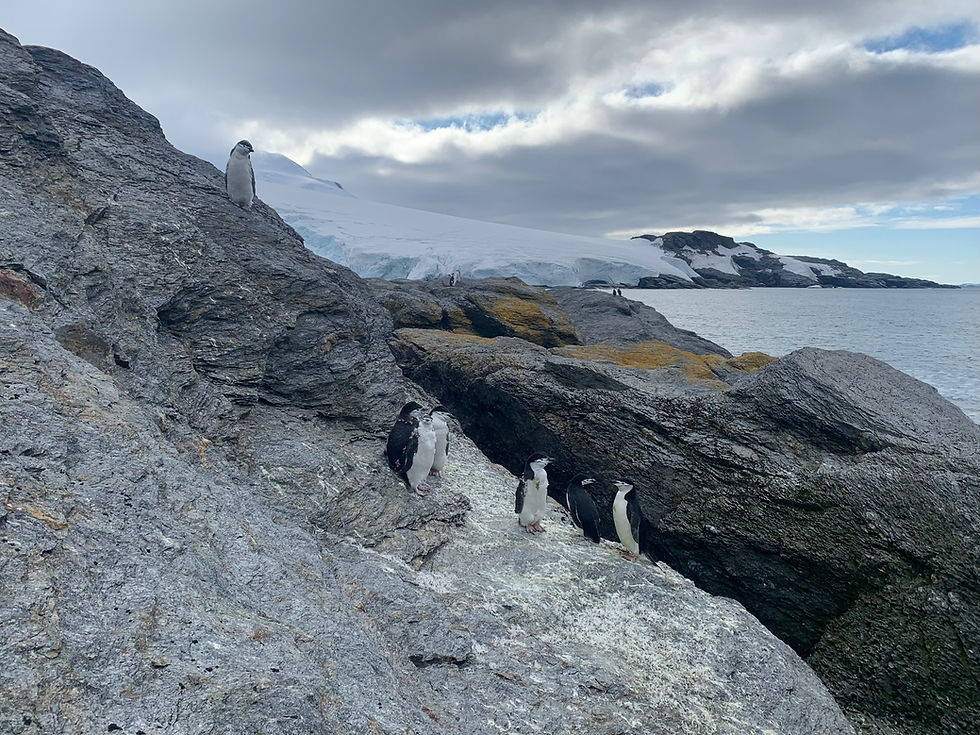
South Orkney Islands (UK/Antarctic Treaty)
Situated within a severe, ice-locked maritime environment, this mountainous archipelago is covered in permanent glaciers. Ground flora is exceptionally sparse, consisting of cold-hardy crustose lichens and meltwater algae growing on bare nunataks. The surrounding sea ice is key to a thriving benthic invertebrate ecosystem, while the rugged coastlines act as nesting platforms for cape petrels, snow petrels, Adélie penguins, and wintering crabeater seals.

Bouvet (NO)
Bouvet Island, a remote volcanic mass in the Antarctic (AN) realm, lacks trees but supports glaciers, mosses, and massive colonies of polar seabirds
Bouvet Island (NO)
As the most remote uninhabited island on Earth, this volcanic mass is nearly entirely covered in thick glacial ice. Its sheer basaltic cliffs and brutal sub-zero maritime climate allow for zero vascular plants; only minimal mosses survive on exposed rocks. Animal presence is restricted entirely to the coastline, acting as a crucial breeding sanctuary for chinstrap and macaroni penguins, Antarctic fur seals, and Southern Ocean seabirds.
Comparative Overview of Key Sub-Antarctic Island Groups
Island Group & Authority | Ecosystem Type | Key Flora | Dominant Fauna & Endemism |
|---|---|---|---|
Auckland Islands (NZ) | Cool temperate tundra & Southernmost tree-fern forests | Olearia (tree daisies), Southern rata, giant megaherbs | Yellow-eyed penguins, Auckland teal, New Zealand sea lions |
Campbell Island (NZ) | Windswept tundra & peat bogs | Dense tussock grasses, colorful megaherbs | Southern royal albatross, Campbell Island snipe |
Macquarie Island (AU) | Hyper-maritime oceanic tundra | Lichens, mosses, pleurophyllum megaherbs | Endemic Royal penguins, King penguins, Elephant seals |
The Snares / Tini Heke (NZ) | Dense sub-Antarctic Olearia forest | Olearia lyallii forest (80% canopy) | Endemic Snares crested penguin, 2M+ Sooty shearwaters |
Antipodes Islands (NZ) | Volcanic coastal tundra | Tussock sedges, shield ferns | Endemic Antipodes Island parakeet, Erect-crested penguins |
Bounty Islands (NZ) | Arid, barren volcanic rocks | Almost completely devoid of land vegetation | Bounty Island shag, Salvin's albatross, Fur seals |
Ecological Themes
The Megaherb Phenomenon: Due to the lack of grazing mammals and a low-temperature, high-nutrient cycle, these islands are famous for "megaherbs"—unusually massive perennial wildflowers with broad leaves and rich pigmentation adapted to low sunlight.
Avian Dominance: Lacking native land mammals, birds evolved to fill terrestrial niches. The islands host 10 distinct albatross species and the world's most dense concentrations of burrowing petrels and endemic parakeets.
Predator-Free Sanctuaries: While groups like the Auckland and Campbell islands suffered from historical pest introductions (now largely eradicated), The Snares remain one of the few entirely pristine, predator-free islands left on Earth.
The Antarctic (AN) biogeographic realm serves as the planet's ultimate test of evolutionary endurance, stretching from the frozen interior of the mainland to windswept sub-Antarctic volcanic islands. This overview highlights how extreme geographic isolation, freezing marine currents, and a complete absence of native land mammals have allowed unique ecosystems to develop. Driven by rich offshore krill webs and microscopic land communities, this polar realm features highly specialized lichens, megaherbs, and globally vital breeding sanctuaries for marine mammals and pelagic seabirds.
References
Antarctic Treaty Secretariat. (n.d.). ASPA 109: Moe Island, South Orkney Islands. Antarctic Protected Areas Database. https://www.ats.aq/devph/en/apa-database/14 |
Antarctic Treaty Secretariat. (n.d.). ASPA 110: Lynch Island, South Orkney Islands. Antarctic Protected Areas Database. https://www.ats.aq/devph/en/apa-database/15 |
Australian Antarctic Division. (2025, April 14). Plants of Heard Island and McDonald Islands. Australian Government Department of Climate Change, Energy, the Environment and Water. https://www.antarctica.gov.au/antarctic-operations/stations/other-locations/heard-island/nature/plants/ |
Bergstrom, D. M., & Selkirk, P. M. (1997). Vegetation of the McDonald Islands, sub-Antarctic. Polar Biology, 17(5), 436–443. doi.org |
Biersma, E. M., Jackson, J. A., & Linse, K. (2025). Southern Islands Vascular Flora (SIVFLORA) dataset: A global overview of sub-Antarctic and cold-temperate island plants. Nature Scientific Data, 12(1), 185-199. doi.org |
Burton, R., & Croxall, J. P. (2022). A field guide to the wildlife of South Georgia (2nd ed.). Princeton University Press. doi.org |
Casanova-Katny, A., Torres-Mellado, M., & Palfner, G. (2020). The vegetation of the South Shetland Islands and the climatic change. In M. Kottek (Ed.), Antarctic peninsula - Landscape, geology and biodiversity (pp. 112-134). IntechOpen. doi.org |
Chown, S. L., & Froneman, P. W. (Eds.). (2008). The Prince Edward Islands: Land-sea interactions in a changing ecosystem. Sun PReSS. |
Chown, S. L., Greenslade, P., & Marshall, D. J. (2006). Terrestrial invertebrates of the sub-Antarctic Îles Kerguelen. African Entomology, 14(1), 115–123. |
Connan, M., Lebreton, L., & Cherel, Y. (2024). Inter-annual and spatial variations in the diet of top predators at the Crozet Islands. Marine Ecology Progress Series, 726, 89–104. doi.org |
Cooper, J. (Ed.). (2003). Seabirds and seals at the Prince Edward Islands. African Journal of Marine Science, 25(1), 415-562. doi.org |
Department of Climate Change, Energy, the Environment and Water. (2026, April 16). Heard and McDonald Islands. Australian Government. https://www.dcceew.gov.au/parks-heritage/heritage/places/world/heard-mcdonald |
Edin Whitehead. (2017, January 1). An introduction to subantarctic New Zealand. https://www.edinz.com/2017/01/introduction-subantarctic-new-zealand/ |
File:Adelie penguins in the South Shetland Islands.jpg. (2026, March 16). Wikimedia Commons. Retrieved June 15, 2026, from https://commons.wikimedia.org/w/index.php?title=File:Adelie_penguins_in_the_South_Shetland_Islands.jpg&oldid=1182261255 |
File:Bouvet Island west coast glacier.jpg. (2026, January 7). Wikimedia Commons. Retrieved June 15, 2026, from https://commons.wikimedia.org/w/index.php?title=File:Bouvet_Island_west_coast_glacier.jpg&oldid=1143335386 |
File:Chinstrap Penguins in South Orkney Islands.jpg. (2025, November 30). Wikimedia Commons. Retrieved June 15, 2026, from https://commons.wikimedia.org/w/index.php?title=File:Chinstrap_Penguins_in_South_Orkney_Islands.jpg&oldid=1123592585 |
File:Heard Island (cropped).jpg. (2024, March 30). Wikimedia Commons. Retrieved June 15, 2026, from https://commons.wikimedia.org/w/index.php?title=File:Heard_Island_(cropped).jpg&oldid=864371443 |
File:Vagues et manchots à l'assaut de la plage.jpg. (2026, March 10). Wikimedia Commons. Retrieved June 15, 2026, from https://commons.wikimedia.org/w/index.php?title=File:Vagues_et_manchots_%C3%A0_l%27assaut_de_la_plage.jpg&oldid=1178919327 |
File:View of Cooper Bay, South Georgia, British Overseas Territory of South Georgia and the South Sandwich Islands.jpg. (2026, June 3). Wikimedia Commons. Retrieved June 15, 2026, from https://commons.wikimedia.org/w/index.php?title=File:View_of_Cooper_Bay,_South_Georgia,_British_Overseas_Territory_of_South_Georgia_and_the_South_Sandwich_Islands.jpg&oldid=1225445355 |
File:Volcan du Diable (Kerguelen islands).jpg. (2024, November 7). Wikimedia Commons. Retrieved June 16, 2026, from https://commons.wikimedia.org/w/index.php?title=File:Volcan_du_Diable_(Kerguelen_islands).jpg&oldid=953768886 |
García-Descalzo, L., Alcazar, A., & Baquero, F. (2025). Cold-loving microorganisms in Antarctic glaciers: A review of South Shetland archipelago glaciers. Antarctic Science, 37, Article e24. doi.org |
Government of South Georgia & the South Sandwich Islands. (2024). South Georgia terrestrial biodiversity action plan 2024–2029. GSGSSI. www.gov.gs |
Lebouvier, M., & Frenot, Y. (2021). Conservation and management of the terrestrial ecosystems of the Crozet and Kerguelen Islands. Polar Record, 57(3), 212–228. doi.org |
Mouse-Free Marion Project. (n.d.). About the island. mousefreemarion.org |
Norwegian Polar Institute. (2024). Bouvet Island. npolar.no |
Oceanwide Expeditions. (n.d.). Flora and fauna of the South Orkney Islands. https://oceanwide-expeditions.com/to-do/experiences/south-orkney-islands-flora-fauna |
Oceanwide Expeditions. (n.d.). South Shetlands flora and fauna. https://oceanwide-expeditions.com/to-do/experiences/south-shetlands-flora-and-fauna |
One Earth. (2020). Antipodes Subantarctic Islands Tundra. https://www.oneearth.org/ecoregions/antipodes-subantarctic-islands-tundra/ |
One Earth. (2020). Marielandia Antarctic tundra. oneearth.org |
One Earth. (2020). Scotia Sea Islands Tundra. oneearth.org |
One Earth. (2020, September 23). South Orkney Islands tundra. Ecoregions Dataset. https://www.oneearth.org/ecoregions/south-orkney-islands-tundra/ |
One Earth. (2020a). Antarctica realm & subrealms. oneearth.org |
One Earth. (2020a). Southern Indian Ocean Islands Tundra. https://www.oneearth.org/ecoregions/southern-indian-ocean-islands-tundra/ |
One Earth. (2020b). Scotia Sea Islands Tundra. oneearth.org |
One Earth. (2020c). Southern Indian Ocean Islands Tundra. oneearth.org |
South African National Antarctic Programme. (n.d.). Prince Edward Islands. Department of Science and Innovation. sanap.ac.za |
Terres Australes et Antarctiques Françaises. (n.d.). L’archipel de Crozet. Réserve Naturelle Nationale des Terres Australes Françaises. taaf.fr |
Terres Australes et Antarctiques Françaises. (n.d.). L’archipel des Kerguelen. Réserve Naturelle Nationale des Terres Australes Françaises. taaf.fr |
UNESCO World Heritage Centre. (n.d.). New Zealand Sub-Antarctic Islands. United Nations. https://whc.unesco.org/en/list/877/ [1, 2, 3] |
Verhulst, J., Bost, C. A., & Guinet, C. (2025). Foraging ecology and population dynamics of top predators in the Kerguelen marine ecosystem. Marine Ecology Progress Series, 732, 141–158. doi.org |
Wang, Z., Zhang, L., Liu, Y., & Zhang, J. (2025). Predicted habitat and areas of ecological significance shifts of 14 top predators in the South Shetland Islands under climate change. Frontiers in Marine Science, 12, Article 1554232. doi.org |
Weimerskirch, H., Delord, K., & Barbraud, C. (2025). Long-term monitoring of albatross and petrel populations at the Crozet Islands in relation to environmental change. Antarctic Science, 37(1), 45–58. doi.org |
Woehler, E. J. (2006). Status and conservation of the seabirds of Heard Island and the McDonald Islands. In K. Green & E. J. Woehler (Eds.), Heard Island: Southern Ocean sentinel (pp. 128–155). Surrey Beatty & Sons. |
World Wildlife Fund. (2024). Antarctic realm ecoregions. worldwildlife.org |
World Wildlife Fund. (2024). Antarctic realm. worldwildlife.org |


Comments