
Layering
- Shanti

- Jan 6, 2025
- 9 min read
What is layering?
Layering is the development of adventitious roots on the stem while it is still attached to the parent plant. The rooted and layered stem is then detached from the parent
plant. Because of this, layering may be regarded as a preparation for subsequent division.
Many groundcover plants develop adventitious roots along the length of the stem when lying directly on the soil surface. These include: Ajuga reptans, Campanula portenschlagiana, Lotus berthelotii, Aurinia saxatilis, Viola species, Heterocentron elegans.
While some plants do develop roots readily along their stems by merely being surrounded by soil, generally it is necessary to restrict the flow of materials within the conducting tissues of the stem, as well as excluding light by blanching or etiolation to cause the initiation of the roots.
While many plants are suitable for layering (see Appendix 1), those plants which produce runners or stolons, those which sucker freely, and those which have a crown-
type habit, are often extremely successful.
Advantages and limitations
Advantages
Layering is a good form of propagation in the following circumstances:
when there are limited facilities for alternative methods of vegetative propagation other than open-ground propagation, such as budding and hardwood cuttings. In some situations it may not be possible to construct structures or install services to provide the necessary facilities for mist propagation, heated structures etc.
to produce a larger plant over a shorter time-scale as compared with cutting propagation. For example, plants such as Rhododendron spp., Corylus maxima 'Purpurea' (purple giant filbert), Magnolia spp., Gordonia axillaris, Calliandra spp., and Metrosideros spp., can be produced for sale quickly through layering.
for the production of those plants which are more satisfactorily grown on their own roots and arenot easily or economically propagated from cuttings without special equipment--for example,Rhododendron, Magnolia, Syringa spp. The success of layering plants that are difficult to propagate is due to the fact that water and minerals are continualy supplied to the layered shoot; this is because the stem is not severed and the xylem remains intact. Thus layering does not depend upon the length of time that a severed shoot (cutting) can be maintained before rooting occurs.
for thelarge-scale open-ground production of clonal rootstocks such as the Prunus avium (Mazzard) selection Mazzard F12/1, and the Malus rootstock.
for a specialistnursery to propagate a small number of plants on site from a stock that may be on the decline, and for a botanical garden to reproduce a limited number of potential specimens for display.
for the preservation of the parent plant, because the parent plant is not destroyed if the layer is unsuccessful.
Limitations of layering
The limitations of layering are: the cost, the area of land needed, the skill and experience needed, the difficulties of mechanisation, disease control and weed control.
Cost
Layering is generally a more expensive technique than other methods, due to:
high labour costs
high cost of land
smaller number of plants produced per stock plant.
Land requirement
Extensive areas of land are usually required for sufficient numbers of stock plants.
Skill and experience
Some of the techniques are straightforward but others require a knowledge gained
only by experience and skill, particularly in relation to the timing of cultural aftercare.
Mechanisation
Layering is not an easy method to mechanise.
Disease control
The build-up of soil-borne diseases and their subsequent infection of the developing layers may be a problem over the years.
Weed control
It's difficult to implement a chemical weed control program due to possible damage to the newly developing shoots.
Plant regeneration
There are essentially two basic principles involved in successfully layering:
The stem needs to be constricted.
Light must be excluded from the stem.
Constriction of the stem
The induction of a constriction in the stem is produced by bending, cutting or twisting.
This restricts the flow of carbohydrates, auxins and other growth factors, which are formed in the leaves and growing shoot tips and translocated downwards; they then accumulate at the point of constriction, promoting the initiation and subsequent development of roots at or near the point of treatment. Rooting occurs in this general area even though the stem is still attached to the parent plant.

Exclusion of light from the stem
The exclusion of light from the stem can be either by blanching or etiolation.
Blanching
If the plant being layered is already in existence (for example, a shoot or tree branch) and it is then covered and light is excluded, blanching occurs.
The exclusion of light causes the stem to lose colour and take on a lighter or blanched appearance. Examples of how to blanch the stem are in Figure 2 and 3.

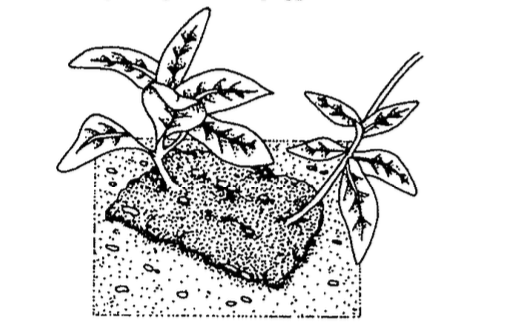
Another example of blanching can be seen when a branch is aerial-layered

Etiolation
If the stem has not previously been exposed to light, etiolation occurs; that is, the shoots are produced in complete darkness and are leafless--for example, in trench layering (see Figure 5).

Exclusion of light is thought to decrease the amount of material deposited in the cell wall and to increase the number of parenchyma cells in the treated area of the stem.
Also, because auxins tend to break down faster in the presence of light than in darkness, the darkened area has higher level of auxins compared to the rest of the stem; this high level of auxins in combination with a higher level of carbohydrates facilitates root production.
So in summary, we have several processes being affected by the darkening of the stem and the constriction of the stem, namely:
higher levels of available carbohydrates, and therefore potentially higher. respiration rates;
auxins accumulating at high concentrations--which aids cell division; • higher number of parenchyma cells initiated due to the darkened area.
Others factors in regeneration
Other factors which may affect the formation of adventitious roots on an attached stem are: moisture, the qualities of the medium, temperature and the health of the mother plant.
Moisture
Root formation in layers depends on continuous moisture in the rooting zone.
Medium
The type of medium around the area of the stem where the roots are to form should have a high air-filled porosity, as well as good water-holding capacity. Substances such as wet peat moss or sphagnum moss are suitable.
Temperature
You will need to maintain moderate temperature in the rooting zone. Excessively
high temperatures in the upper layers of the soil during the root initiation stage may reduce moisture content, not only inhibiting rooting but injuring the shoots as well. Temperatures which are too low will affect the respiration rate and root initiation, so development will be slow.
Selection of stock plant (mother plant)
It is important to recognise that the source and quality of the initial mother material is an essential factor for success. Items to check for include:
trueness-to-name
virus-free material
Layering techniques
An effective method of classifying the different layering techniques is based essentially on the stem and soil relationship used.
The stems are lowered and placed into the soil.
simple layering
compound (serpentine) layering
tip-layering
dropping and dividing
Soil is mounded up to the stem (earthing up).
mound (stool) layering
trench (etiolation) layering
continuous (French) layering
The stems are not covered by the soil.
aerial (Chinese) layering (marcottage).
Stems in the soil
Simple layering
Simple layering is probably the best-known layering technique for most professional and amateur growers. An extremely wide diversity of woody plants has been successfully propagated by this method, ranging from someof the small alpine shrubs to conifers and large broad-leaved trees.
Simple layering involves the constriction of the stem, normally by bending or twisting, followed by siting and pegging a length of stem below soil level while still attached to the parent plant. Root initiation and development is promoted by the constrictionassisted by the blanching caused by covering with soil, especially in those stems laid down during the summer while in growth.
Some plant species suitable for simple layering include: Rhododendron spp.,
Magnolia spp., Juniperus sabina, Juniperus squamata, Chamaecyparis lawsoniana, and many groundcover-type plants.

Compound (serpentine) layering
Compound or serpentine layering is a traditional technique used for plants with long, flexible stems such as the climbing vines, Clematis, Vitis, Wisteria (see
Figure 7).
It may be defined as a modification of simple layering in which the stems are multiple-layered by being placed below soil level at a number of locations along their length, usually at the node.
Today this technique has little commercial application as other methods are more effective. Compound layering is best performed in early spring.

Tip-layering
This method is a modification of simple layering that was traditionally used for the fruiting Rubus species, such as loganberry and blackberry in the UK and USA. In Australia this technique is hardly ever used.

Tip-layering depends on the acute bending of the soft growing tip during the summer to place it beneath the soil level. This encourages rapid root development with a minimum of stem growth.
It does represent the quickest turnabout period from the time of layering to lifting, and relies on stem constriction and etiolation.
The intensive method of using single-leaf bud cuttings has reduced tip-layering to minor significance today.
Dropping and dividing
This technique is actually a form of division but is sometimes included as a layering technique because it relies on the principle of blanching to encourage rooting of the stems. It helps to ensure that more roots develop along the stem of some plants compared to those that form on shoots removed by conventional division (eg Berberis spp.).

Earthing up
Mound (stool) layering
Stooling or mound layering involves the induction of adventitious roots at the base
of stemsbymoundingup soilso as ot exclude light by blanching; or reducing the mother plant to a basal stub and mounding up soil so the new shoots which develop are etiolated below ground level.
Plants suited to this technique must produce numerous new crown shoots to withstandthe cutting back of the stem growth each year, so that vigorous shoots will be available annually.
Mound layering is best suited to material with an upright growth habit that otherwise could be damaged if brought down horizontally into the soil.
Specific examples include:
Malus spp. as understocks Azalea spp.
Chaenomeles japonica
Syringa vulgaris
Rhododendron (dwarf cultivars)
Prunus glandulosa and cultivars

Trench (etiolation) layering
This techniques serves as the basis for the vegetative propagation of Prunus avium (Mazzard F12/1 rootstocks), although it has been used also on such crops as quince, mulberry, apple and walnut. It involves the initiation and development of roots at the base of a stem by virtually excluding light during the early part of shoot development from a mother plant trained to grow horizontally in a shallow trench.
It differs from stooling or mound layering in thatthe developing shoots are covered with soil in the early growth phase while still leafless and thus are etiolated (not previously exposed to light), whereas shoot growth in stooling has occurred and chlorophyll is present prior to mounding-up the soil. Thus, the stems are blanched after development in stooling.


Continuous (French) layering
This technique is a cross between trench and compound layering, and is used for the propagation of some ornamental species. It is not a technique which is used commercially in Australia.


Comments